Mostrando entradas con la etiqueta científicos. Mostrar todas las entradas
Mostrando entradas con la etiqueta científicos. Mostrar todas las entradas
lunes, 22 de junio de 2015

martes, 16 de junio de 2015
Experimento Eratóstenes
Experimento Eratóstenes
12 de junio de 2015. Alcobendas (Plaza del Ayuntamiento y Centro Cultural Pablo Iglesias)
Organizado por el Instituto de Ciencias Matemáticas con la colaboración del Ayuntamiento de Alcobendas.
El pasado 12 de junio 200 escolares conmemoraron el experimento de Eratóstenes, el sabio griego que fue capaz de aproximar el radio de la Tierra en el siglo III a. C. Siguiendo sus mismos pasos, los estudiantes midieron, en el momento en el que el Sol está más alto en el cielo (el medio día solar) la longitud de la sombra de los palos verticales que habían preparado para el experimento: sus propios gnómones. La medición se hizo en la plaza del Ayuntamiento de Alcobendas y contó con representantes de la institución. Participaron los IES de Alcobendas Ágora, Aldebarán y Giner de los Ríos.
Tras obtener su aproximación, un grupo de representantes formado por estudiantes de todos los Institutos de Educación Secundaria se juntaron en el Centro Cultural Pablo Iglesias para compartir sus resultados con el resto de países participantes: Argentina, Brasil, India, Francia, Grecia...
Este es el tercer año que el ICMAT participa en esta iniciativa internacional.
Materiales
viernes, 9 de enero de 2015
Joseph-Louis Lagrange
Documental producido por el Instituto Henri Poincaré con motivo del bicentenario del fallecimiento en 2013 deJoseph-Louis Lagrange (1736 – 1813), en coproducción con el CNRS (Centre Nationale de la Recherche Scientifique) y el Instituto Lagrange de París. Recientemente se ha puesto a disposición de todos este documental en la red (más adelante se indica el enlace) y por ello me ha parecido interesante compartirlo y que, de paso, valoréis si merece o no la pena realizar y divulgar este tipo de documentos.

Previamente una pequeña ficha técnica.
Título Original: Lagrange. Nacionalidad: Francia, 2013. Dirección: Quentin Lazzarotto. Dirección Científica: Frederic Brechenmacher. Animación Gráfica: Arthur Milleville. Música: Arthur Dairaine Andrianaivo. Producción: Cédric Villani, Jean-Philippe Uzan para el Henri Poincaré Institute (IHP), en coproducción con CNRS Images y el Instituto Lagrange de Paris. La película ha recibido financiación de la Universidad Pierre y Marie Curie, y de Labex Carmin. Duración: 33 min.
Colaboradores: Luigi Pepe (Universidad de estudios de Ferrara), Jérôme Pérez (Profesor del ENSTA Paristech), Silvia Roero (Universidad de estudios de Torino), Cédric Villani (Universidad de Lyon, Director del Instituto Henri Poincaré), Bruno Belhoste (Universidad Paris 1), Alberto Conte (Presidente de la Academia de Ciencias de Turín), Laurent Guin (Estudiante de tercer año en L’Ecole Politechnique), Eberhard Knobloch (Miembro de la Academia de las Ciencias de Berlín-Brandenburgo), Jacques Laskar (CNRS, Observatorio de París, Miembro del Bureau de las longitudes, entre otros cargos), Thomas Morel (Universidad Técnica de Berlín), Anne-Sophie Bonnet-Bendhia, Jenny Boucard, Maria Munoz.
El documental sigue un esquema clásico de localización de lugares que marcan la vida y la obra del personaje según se desgrana su biografía, salpicado por intervenciones de prestigiosas personalidades que lo han estudiado y/o trabajado. Antes del título, algunos de ellos nos hacen, en pocas palabras, una semblanza de lo que destacarían de Lagrange: unos destacando su trabajo matemático, otros en Física, Astronomía, en su trabajo académico, y algunos nos adelantan detalles de su personalidad. Tras ese preámbulo, visitaremos las tres ciudades que marcaron con mayor incidencia su existencia: Turín, Berlín y París.
 En Turín, el matemático y actualmente Presidente de la Sociedad Italiana de Historia de las Matemáticas, Luigi Pepe aparece recorriendo la Via Lagrange en busca del portal nº 29, edificio donde nació Lagrange. ¿A que pensabais que era francés? Pues no, piamontés, de nombre Giuseppe Luigi Lagrange, como se muestra en una lápida de la casa natal. De paso se nos va contando cómo su padre fue tesorero público del Estado y su madre hija de un rico doctor de Cambiano, que tuvieron once hijos, siendo nuestro Lagrange el primogénito. A los 14 años ingresó en la Universidad de Turín donde estudió durante dos años entre otros el Introductio in analysin infinitorum (Euler, 1748) (para muchos “el libro de texto más importante de los tiempos modernos”), el tratado de Wolff, el libro de Agnesi o el de cálculo integral de Johann Bernoulli, entre otros. Después trabajó como colaborador ayudante de los profesores de matemáticas en la Academia Militar de Turín, dando clase a personas siempre mayores que él.

Como el documental puede verse íntegro (en francés; no obstante en este enlace además se puede ver subtitulado en inglés), no me parece oportuno detallarlo al completo, simplemente destacar algunas curiosidades como que Lagrange, a diferencia de otros que trabajaron como filósofos, físicos u otras disciplinas, siempre lo haría como matemático; que le disgustaban profundamente las visitas y la vida social; que siempre trabajaba sin descanso alguno de 6 de la tarde a 12 de la noche; que la Revolución francesa le pilló en mal momento y por supuesto que su producción científica es de las más destacables de la Historia.
Personalmente no conocía los denominados puntos de Lagrange. Están muy relacionados con un problema clásico que abordó Lagrange: el problema de los tres cuerpos. Todos hemos estudiado que la atracción gravitatoria que un cuerpo ejerce sobre otro de distinta masa es directamente proporcional al producto de dichas masas, e inversamente proporcional al cuadrado de la distancia que los separa. Incluso podemos sin demasiada dificultad escribir la fórmula que sintetiza dicha ley, universalmente conocida como ley de gravitación universal, y que fue expuesta por Isaac Newton. Con dos cuerpos por tanto, la cosa está bastante clara. Sin embargo las cosas se complican, y mucho, cuando entran en escena tres o más cuerpos. De hecho, hoy conocemos que la dinámica de tres cuerpos es caótica, tan irregular que presenta indicios de aleatoriedad. Hasta finales del siglo XIX, poco se sabía sobre el movimiento de tres cuerpos celestes, aunque uno de ellos fuera de una masa poco menos que despreciable.  Lagrange estudió lo que se denomina el problema restringido, es decir, considerando que las órbitas fueran o bien circulares o bien elípticas. En el caso circular, se demostró la existencia de cinco puntos de equilibrio, los puntos de Lagrange, denominados así en su honor. En la imagen (tomada de la Wikipedia) aparecen detallados esos puntos y sus curvas de potencial (sólo aparecen dos cuerpos, el Sol y la Tierra). Quien desee profundizar un poco (nivel elemental) sobre el asunto, una vez visinado el documental, puede consultar la entrada de donde se ha tomado la imagen, aquí. El problema de los tres cuerpos, que comenzó siendo una mera curiosidad matemática, pronto se tornó de suma importancia, esencial para comprender o decidir si nuestro sistema solar (o el Universo entero) es o no estable. A este respecto recomiendo vivamente el capítulo octavo del libro Los grandes problemas matemáticos de Ian Stewart dedicado íntegramente a este asunto. Para quien desee aprender algo del mismo a partir de una novela, recuérdese La incógnita Newton, de Catherine Shaw.
Lagrange estudió lo que se denomina el problema restringido, es decir, considerando que las órbitas fueran o bien circulares o bien elípticas. En el caso circular, se demostró la existencia de cinco puntos de equilibrio, los puntos de Lagrange, denominados así en su honor. En la imagen (tomada de la Wikipedia) aparecen detallados esos puntos y sus curvas de potencial (sólo aparecen dos cuerpos, el Sol y la Tierra). Quien desee profundizar un poco (nivel elemental) sobre el asunto, una vez visinado el documental, puede consultar la entrada de donde se ha tomado la imagen, aquí. El problema de los tres cuerpos, que comenzó siendo una mera curiosidad matemática, pronto se tornó de suma importancia, esencial para comprender o decidir si nuestro sistema solar (o el Universo entero) es o no estable. A este respecto recomiendo vivamente el capítulo octavo del libro Los grandes problemas matemáticos de Ian Stewart dedicado íntegramente a este asunto. Para quien desee aprender algo del mismo a partir de una novela, recuérdese La incógnita Newton, de Catherine Shaw.
Volviendo a la reflexión con la que empezaba, una vez producido y realizado el documental, ¿de qué serviría si no se difunde? Pero no sólo comercializándolo o poniéndolo a disposición de todos. El 6 de Diciembre de 2013, uno de los colaboradores del documental, Jérôme Perez, astrofísico teórico del Laboratoire de Mathématiques Appliquées del ENSTA Paristech, organiza un auténtico maratón acerca de Lagrange, uno de cuyos elementos lo constituye el visionado del documental. Quien desee ver todas las conferencias y actos en relación con esta celebración (en francés), puede acceder a través de este enlace.
December 6th : Joseph-Louis Lagrange Bicentenary
organized by Jérôme Perez
Joseph Louis Lagrange is known as an illustrious mathematician, engineer and astronomer. He was born in Turin on 1736, spent thirty years in the Piedmont then twenty-one years in Berlin and the rest of his life in Paris.
He died in Paris on 1813 so 2013 is the bicentenary of his death.
On this occasion, we wanted to take advantage of Gravasco quarter to honor him. A memorial event will take place on December 6th, 2013, as it will be an opportunity to discuss his biography and return on his contributions to astronomy.
Program
December 6th : Joseph-Louis Lagrange Bicentenary
organized by Jérôme Perez
Joseph Louis Lagrange is known as an illustrious mathematician, engineer and astronomer. He was born in Turin on 1736, spent thirty years in the Piedmont then twenty-one years in Berlin and the rest of his life in Paris.
He died in Paris on 1813 so 2013 is the bicentenary of his death.
On this occasion, we wanted to take advantage of Gravasco quarter to honor him. A memorial event will take place on December 6th, 2013, as it will be an opportunity to discuss his biography and return on his contributions to astronomy.
Program
- 9h00-9H30 : Welcome coffee
- 9h30 - 11h30 : Scientific biography of Joseph Louis Lagrange [video of the conference]
- Part one, Lagrange in Turin : calculus of variation and vibrating sring
- Part two, Lagrange in Paris : didactical works and Dean for Scientific activities at the National Institute
- 11h30-12h30 : Commemoration at "Le Panthéon"; Film of the ceremony, Reportage photo : [1], [2]
- 12h30 - 14h00 : Lunch
- 14h00-14h30 : First projection of "Lagrange, an european scientist" [The film]
Documentaire de 33 minutes, Directeur Scientifique (Scientific director) : Frédéric Brechenmacher
Réalisateur (Director) : Quentin Lazzarotto, Production : Cédric Villani et Jean-Philippe Uzan
Produit par l’Institut Henri Poincaré, en collaboration avec l’Institut Lagrange de Paris, le CNRS Images, l’Université Pierre et Marie Curie, le Labex Carmin et l’Unesco. Film inédit. Diffusé en français. - 14h30 - 15h30 : From the stability of the Solar system to the stability of plasmas [video of the conference]
By Cédric Villani, Head of IHP - 15h30 - 16h30 : Lagrange and the stability of the Solar System [video of the conference]
By Jacques Laskar, CNRS, Observatoire de Paris, Bureau des Longitudes, Académie des Sciences - 16h30 - 17h30 : Lagrange and the N body Problem [video of the conference]
By Alain Albouy, IMCCE, Paris
domingo, 4 de enero de 2015
Mathematical fiction
Are you looking for a book or story that might be useful for the students in your math class? Are you interested in what our society thinks about mathematicians? Then you've come to the right place. This database lists over one thousand short stories, plays, novels, films, and comic books containing math or mathematicians.
En esta página aparece mucha información sobre matemáticas y cine
sábado, 3 de enero de 2015
El teorema de Nicómaco
El teorema de Nicómaco
Hacia el año 100, el filósofo y matemático Nicómaco de Gerasa observó que:
13 + 23 + 33 + … + n3 = (1 + 2 + 3 + … + n)2

En efecto, este diagrama lo muestra de manera clara:
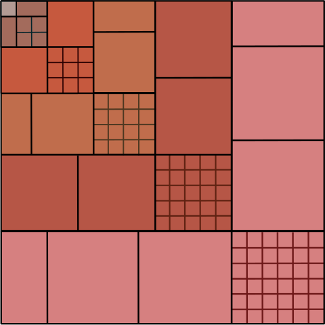
Si contamos los cuadrados individuales, tenemos en total –se cuenta desde el extremo superior izquierdo, y se va descendiendo y contando los cuadrados en cada zona coloreada de diferente tono–:
1 × 12 + 2 × 22 + 3 × 32 + 4 × 42 + 5 × 52 + 6 × 62 =
= 13 + 23 + 33 + 43 + 53 + 63.
Pero, por otro lado, el área del cuadrado completo es claramente:
(1 + 2 + 3 + 4 + 5 + 6)2.
Así, 13 + 23 + 33 + 43 + 53 + 63 = (1 + 2 + 3 + 4 + 5 + 6)2.
Este argumento sigue siendo válido al cambiar 6 por un número natural n cualquiera.
Más información:
- Nicomachus’s Theorem, Wolfram MathWorld
- A visual proof of Nicomachus’s Theorem
- Loren Shure, Nicomachus’s Theorem, Matlab Central, 2010
martes, 30 de diciembre de 2014
The nature of things. Martin Gardner
Resolución de los problemas más famosos de GardnerTop 10Martín
Página con alguna de las mejores contribuciones de Gardner usando el programa wolfram
Martin Gardner Obscure Books
Logic Machines and Diagrams
(McGraw-Hill, 1958, 9 + 157 pages)
The very first article Martin wrote for Scientific American was "Logic Machines" (Mar 1952, Vol 186, No 3, pages 68–73). It was reviewed by none other than Alonzo Church in J. Symbolic Logic (1952, Vol 17, Issue 3, page 217).
In due course, Martin expanded that article into the second book he wrote, though that didn't appear until after Mathematics, Magic and Mystery (Dover, 1956), which had been written later. The logic book was reviewed by W. Mays in J. Symbolic Logic (1959, Vol 24, Issue 1, pages 78–79).
Dover retitled this as Logic Machines, Diagrams and Boolean Algebrafor paperback issue in 1968. A second edition reverted to the original title, had two completely rewritten chapters (including new material on AI), and a foreword by Donald Michie (University of Chicago Press, 1982, 14 + 165).
Oddities and Curiosities of Words and Literature by C. C. Bombaugh
(Dover, 1961, 375 pages)
- This was "Edited and Annotated by Martin Gardner," based on a book from the 1870s by Charles Carroll Bombaugh. It includes "Curiosities of Versification, Irish Bulls, Scissors Verse, Authors' Blunders, Poems Having Shapes, Hoaxes and Frauds, Odd Word Histories, Palindromes, Puzzles and Riddles, Unusual Names, Famous Puns and Word Plays."
Archimedes, Mathematician and Inventor
(MacMillan, 1965, 6 + 42 pages, illustrated by Leonard Everett Fisher)
This was part of the publisher's Science Story Library, aimed at young children. After wrapping up the story with the tale of how 75-year-old Archimedes was killed by a Roman soldier in 212 B.C., Martin concludes with these words:
"The Romans were not much interested in science and mathematics, and more than a thousand years were to go by before there were any scientists as great as Archimedes.The world has long ago forgotten the name of the hot-tempered Roman soldier. It hardly remembers the names of King Hiero and Marcellus, the general.But the name of Archimedes has never been forgotten. Today, in every country, his great discoveries are known and his name is honored."
In later life, Martin often echoed the sentiment than great scientists made a deeper impression on world history than kings and generals.
Never Make Fun of a Turtle, My Son
(Simon & Shuster, 1969, 45 pages, illustrated by John Alcorn)
This contains 19 short "morals for children" poems that Martin published in Humpty Dumpty magazine in the 1950s, here appearing on right-hand pages, matched by appropriate artwork on the facing left-hand pages. Titles include Barbershop, Share Toys, Cry-Baby, Speak Clearly, Medicine, Good Sport, Bedtime and Politeness. It was reviewed in the New York Times Book Review by Harry Schwartz.
Space Puzzles
(Simon and Schuster, 1971, 95 pages, illustrated by Ted Schroeder)
This book, which later resurfaced as Puzzling Questions About the Solar System (Dover, 1997), showcases Martin's deep knowledge of and fascination with the earth, sun, moon, and planets, as well as meteors, comets and asteroids. To put things in perspective, he starts off with the classic question,
"Imagine the earth reduced to the sze of a billiard ball and dried with a towel. You run your fingertips over the surface. Would you be able to feel its mountains and ocean floors?"
Codes, Ciphers, and Secret Writing
(Simon and Shuster, 1972, 96 pages).
This book, appearing as it did just a few years before cryptography was totally revolutionized by RSA methods—a story Martin himself broke to the general public— had chapters on substitution and polyalphabetic ciphers, in addition to old-fashioned methods including invisible writing.
Puzzles From Other Worlds: Fantastical Brainteasers from Isaac Asimov's Science Fiction Magazine
(Vintage, 1984, 12 + 189 pages)
This is the second and least well known of the three batches of the whimsical "puzzle tale" columns that Martin contributed to Isaac Asimov's Science Fiction Magazine between 1977 and 1986. There is great mathematical material hiding in between these covers.
How Not to Test a Psychic: Ten Years of Remarkable Experiments With Renowned Clairvoyant Pavel Stepanek
(Prometheus, 1989, 264 pages).
The title says it all. Martin surveys how academics in respectable institutions allowed themselves to be hoodwinked into believing that so-called psychics have special powers, as a result of being blind to basic methods of deception that are well known to conjurors.The Universe in a Handkerchief: Lewis Carroll's Mathematical Recreations, Games, Puzzles, and Word Plays
(Copernicus/Springer-Verlag, 1996, 10 + 158 pages)
Having already explored the Alice and Snark books in great detail, here Martin goes hunting for fun in other works by Carroll, in the chapters Fiction and Verse, The Diaries, Letters, Books and Articles, Miscellaneous Amusements, Doublets, and Pamphlets on Games.Optical Illusion Play Pack (with Gilbert Ford)
(Sterling, 2008, 59 pages)
Even in his earliest puzzle collections, Martin had included optical illusions, those being a keen interest of his all his life. A few years before his death, he worked with illustrator Gilbert Ford on this volume. In many ways, it resembled some of the material he published in "Humpty Dumpty" in the 1950s; readers had to cut out and fold paper or cardboard to form props with interesting properties.
One of the 28 items included there is the motion parallax based "Rotating House" illusion, in which a stationary object gives the impression of moving as one walks around it. This has its roots in the work of Martin's friend Jerry Andrus, to whom this book is dedicated, and it reached new heights of effectiveness (and popularity) via the Thinky the Dragon illusion a few years later. (This was highlighted as part of the Martin inspired Mathematics Awareness Month 2014, which includes an explanation of the corresponding mathematics.)


Vídeo sobre la contribución de este periodista sin formación matemática que ha influido a tantos matemÁticos a través de su columna en scientific american.
El vídeo se titula The Nature of Things
viernes, 12 de diciembre de 2014
Fermi y sus problemas
Link
Enrico Fermi fue un físico italiano responsable junto con otros del uso de la energía nuclear, y que se exilió a EEUU antes del comienzo de la 2 guerra mundial. Pero en este post de lo que vamos a hablar es de una de las aficiones, las aproximaciones. Planteaba preguntas del tipo: Cuántos pianos hay en NY?, y con una asombrosa racionalidad daba alucinaciones muy cercanas a los valores reales. De ahí que a estos problemas se les haya puesto el nombre de Problemas de Fermi
Suscribirse a:
Entradas (Atom)